A gallery with images showing this copy’s progress.
A gallery with images showing this copy’s progress.
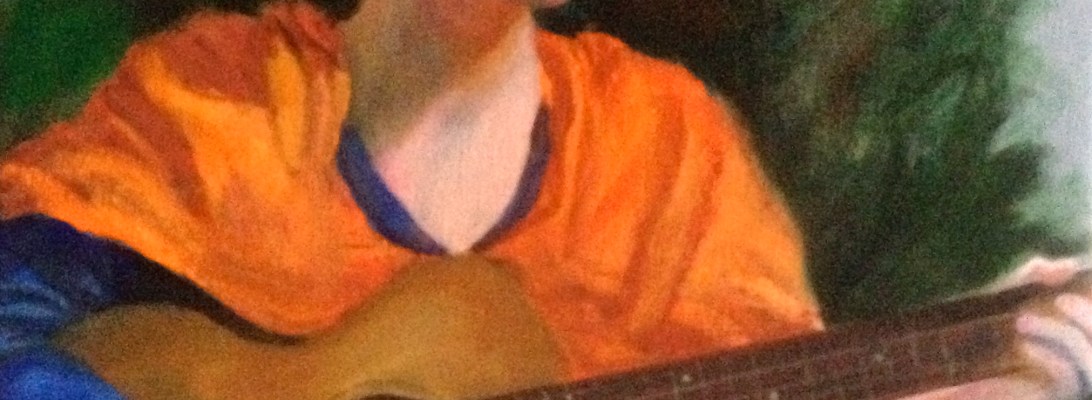

Portrait of Julia, a lovely girl who models in Danni Dawson’s class at the Art League School in Alexandria. The painting was done from life during class. Julia, an exceptionally good model, posed with a guitar to which she added a wonderfully mysterious and pensive look.
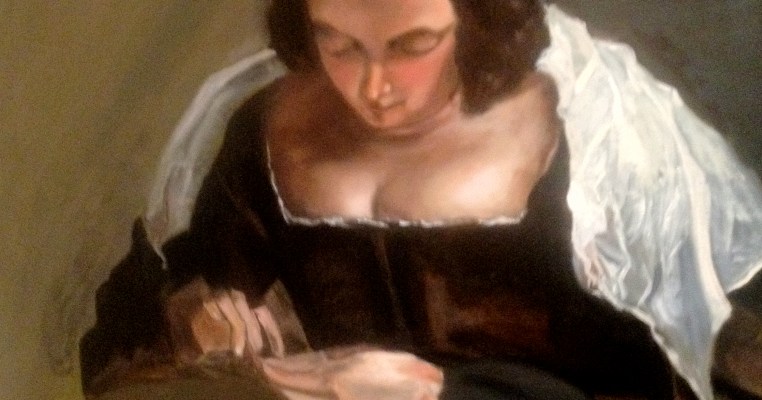
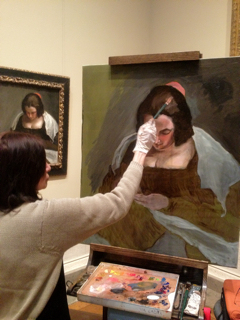
The Needlewoman by Diego Rodriquez de Silva y Velazquez (1566-1660), Spanish, was the second project attempted in the Copyist program. Because The Needlewoman was an unfinished portrait with little detail, the copying process took only 4 Tuesdays to complete, about 20 hours. The head of The Needlewoman was modeled in light and shadow and is the most fully realized part of this painting as opposed to the remainder of the painting including the arms, hands, etc., which are sketched in only briefly. The resulting painting displays the Velazquez facility to portray gesture and his ability to suggest the subject melding into the background. It is believed that The Needlewoman was not completed by Velazquez. The painting was found upon examination of the inventory in his home at the time of his death. The Needlewoman is very similar to several of his other works.
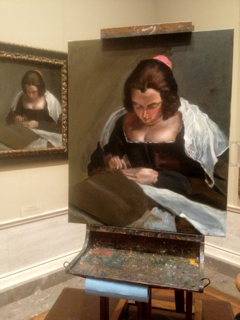
I participated in a workshop entitled “Painting in the Manner of Velazquez” with Robert Liberace in the summer of 2011 at the Art League School in Alexandria, Virginia. I was intrigued by the Velazquez style and therefore welcomed the opportunity to copy an original at the National Gallery of Art. During the workshop I used authentic paints as were used in Velazquez’s time. I prepared my linen canvas according to conventions of the period. I felt transformed back in time. Many of Velazquez’s paintings were dark compared to other more colorful painters of his time. However, he put down paint beautifully, very thin paint, almost nothing at times and yet in chiaroscuro style achieved a luminosity that made his work glow.
I learned a great deal from the study of Velazquez. How much? You be the judge.

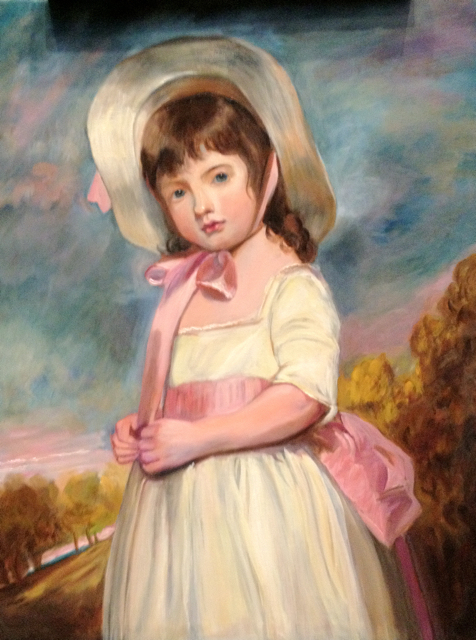
Miss Juliana Willoughby was my first copying project at the NGA. The most difficult part of copying the work of a Master artist is not copying the subject, it is trying to recreate the hues of the period the painting was created. It’s amusing that some visitors comment that they like my colors better. They don’t fully consider that the original painting is often hundreds of years old and the paint, of course, has dulled. Some ask if I painted the original. Come on….I don’t think I look that old, but I take that comment as a compliment. Some spectators will point out errors, and give me advise how I can perfect the painting. I take all critiques as a learning experience because as we all know, art is subjective. Actually, the visitors are often the most fun part of the copyist experience.

Although I sometimes feel frustrated at being interrupted, I must say the attention is flattering. I’m often swarmed by groups of visitors with cameras in hand. Each one wants to be photographed with me. How could I be upset with all that attention?
I began the Copyist Program at the National Gallery of Art on October 4th, and although I was excited and eager to begin, I have to admit I was a bit nervous. I wasn’t sure how I was going to handle the crowds of people who visit the museum on a daily basis. The application process for the program took about to 2 months to complete, but the wait was well worth it.
Stop by and see me if you happen to visit the NGA on Tuesdays. I’m on the main floor of the West Wing, from 10am – 4pm. If you don’t see me, I’m probably having lunch in the Cascade Cafe around 12:30 or 1:00.
Hope to see you there!
I begin with a toned cotton or linen canvas or panel. After setting down markings, where the size of the head, body, arms, etc. will go (like a map), I next sketch in the figure using simple large shapes, making sure I mark where the facial features will be, measuring with a paint brush or carefully by sight for accurate distances between the features. The next step is to lay down the darks and the lights, where the shadows will be and where the light falls on the figure. When I’m satisfied my drawing is correct, I follow with the of skin tones and clothing color always paying attention to color relationships. Details are left for the end, kind of the icing on the cake. Hopefully, I will end up with a very satisfying painting as with A Young Girl Reading, after Jean-Honore Fragonard, in preparation for the Copyist Program at the National Gallery of Art, Washington, D.C.
 Sonia Gadra
You must be logged in to post a comment.