Van Gogh and Me

On Tuesday, September 23, I began a new copy at the National Gallery of Art, Washington, D.C. (NGA).  The painting bears the title “Green Wheat Fields, Auvers”, (1890).  A recent acquisition at the NGA, this masterpiece had not been in public exhibition since 1966 and probably not recognized by many as a van Gogh.  It is believed it was most likely painted during the spring/early summer of 1890, just weeks before the end of van Gogh’s life in Auvers-sur-Olse, France.  In this village just north of Paris, and as he did before in the countryside surrounding Arles and Saint-Remy, van Gogh painted what could be called “pure landscapes.”  Van Gogh eliminates the rural figures, stony walls, wooden carts, dramatic trees, and rustic buildings that populate so many of his landscapes and focuses instead on the windblown clouds and tall grasses.  Most of the composition consists of a field in a rich range of greens and blues, punctuated by outbursts of yellow flowers. The artist wrote of his return to northern France as a kind of homecoming, a peaceful restoration in which the vibrant, hot colors of the South were replaced by cool, gentle hues in green and blue.  Van Gogh’s energetic strokes describe the movement of grassy stalks in the breeze.  “Green Wheat Fields, Auvers” may be viewed at the NGA in gallery #83.  I keep it company on Tuesdays from about 10:00 to 4:00.  If you are visiting, stop by and say hello.

Holiday and Special Occasion Ornaments

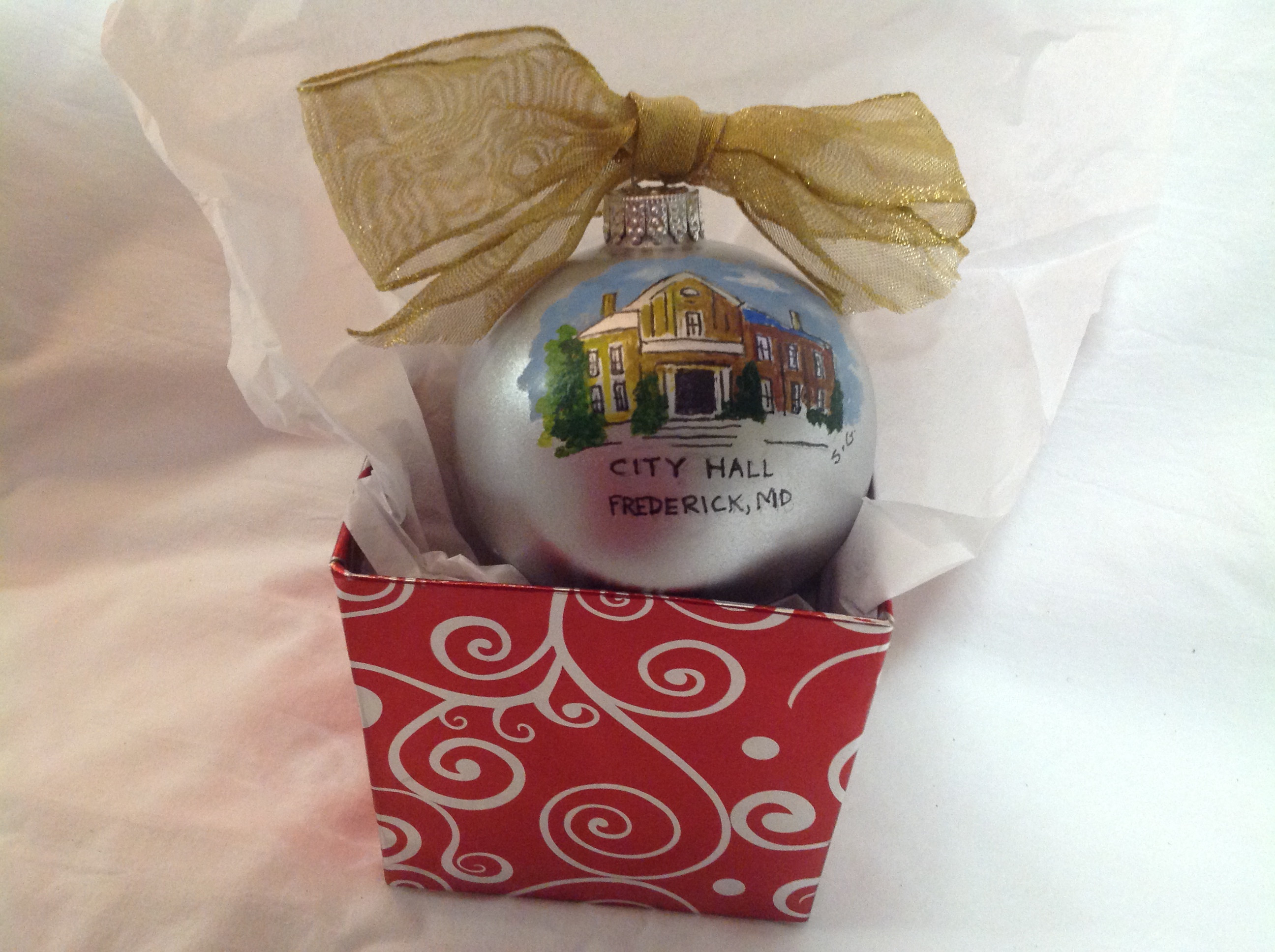
The holidays always seem to be upon us before we know it. Therefore, to be holiday ready, I have started taking orders for my customized hand painted ornaments. These ornaments were very popular last year and, indeed, have remained a favorite gift item throughout the past several months. The hand painting requires much thought and time so I must begin now in order to meet anticipated demand and to purchase materials which sell out early.

The ornaments are of two types. One is a general holiday or special event scenes. They can also be a portrait of a house, place of worship or pet. The second type is a specified scene in the Frederick area such as the clustered spires, the city hall or a landmark in ones hometown.

My goal is to complete every order in time to use as a household decoration or to provide to a third party as a gift. Early ordering will make this goal attainable. These unique hand painted ornaments make a great addition to a permanent collection for any occasion. So order early to be assured of receiving your special treasure on-time.

The sample ornaments shown above are scenes of landmarks around Frederick City and County and Washington, DC. Other scenes may be created from a photograph provided by a customer or taken by me. Images can also be painted on a small 10″X10″ panel or canvas. The cost is $45.00 plus shipping. Please e-mail me at sgadra@me.com for more information and to order.

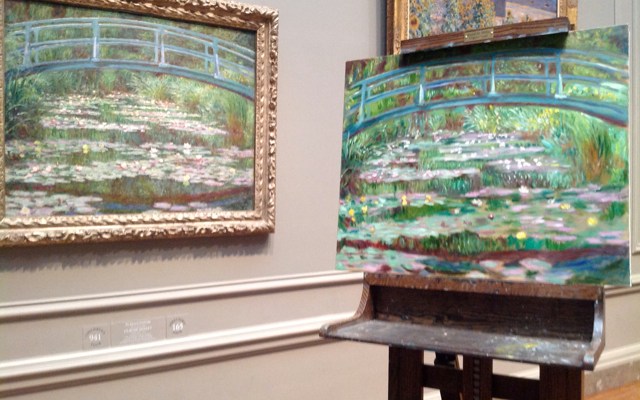
Japanese Footbridge after Claude Monet

Being in the Impressionist Gallery is quite exciting! It is also an extremely busy place.  The gallery is flooded with visitors from all over the world. Visitors seem to be very interested in the impressionists and the works of Claude Monet are probably the most requested of any of the master artists of the impressionist period. Of the large numbers of visitors who come to the National Gallery of Art in Washington, D.C., it seems the majority specifically want to see works of the impressionists.  I enjoy talking to the visitors as much as I enjoy copying Claude Monet’s work!  Perhaps that is why I’ve spent so much time in the Impressionist Galleries.  For me it’s almost like traveling all over the world in one day.  Those fluent enough in English to be able to communicate don’t hesitate to ask all kinds of questions and I make an effort to give them answers to the best of my knowledge.  I try to keep up with some of the art history regarding each artist I copy in order to pass on bits of information.  After all, the Copyist Program is an educational program so I’m not only perfecting my skills as an artist but I’m educating myself (and others) in art history.

Claude Monet was born on November 14, 1840, in Paris, France.  Known as the father of “Impressionism,” he was most concerned with painting form and light rather than realism.  Monet grew up in Le Havre, France, a port town in the Normandy region.  Like many artists, he did not like being confined to a classroom and preferred the outdoors.  His love for drawing as a young child was preparation for his chosen career as he filled his schoolbooks with sketches of people in his community including caricatures of his teachers.  After meeting Eugene Boudin, a local landscape artist, Monet began to explore the natural world in his work.  The world of nature would later become the cornerstone of Monet’s paintings.  As a “plein air” painter he was often accompanied by his contemporaries, Renoir, Sisley and Bazille on his outings.  Monet won acceptance and entry to the famous and much desired Salon of 1865, an annual juried art show in Paris. After fleeing to London with his family during the outbreak of the Franco-Prussian War, Monet eventually returned to France in 1872 and settled in Argenteuil where he visited with Renoir, Pissarro and Edouard Manet who, according to Monet, at first hated him because people confused their names.  Monet sometimes would become frustrated with his work, a common feeling among artists.  It is believed he destroyed a number of paintings, perhaps as many as 500 works.  He would simply burn, cut or kick the offending piece.  Wouldn’t we love to have those works today!

My latest project at the National Gallery of Art,  is Japanese Footbridge, painted by Monet in 1899 in his beloved home of Giverny.  He had the bridge built over a beautiful lily pond just so he could paint it under different light and various points of view.  He planted his gardens with the same purpose, never having flowers of the same color growing next to each other.   Instead, flowers were planted so complimentary colors grew side by side.

I’ll be in Gallery #81 for the next few weeks, come by for a Tuesday visit.

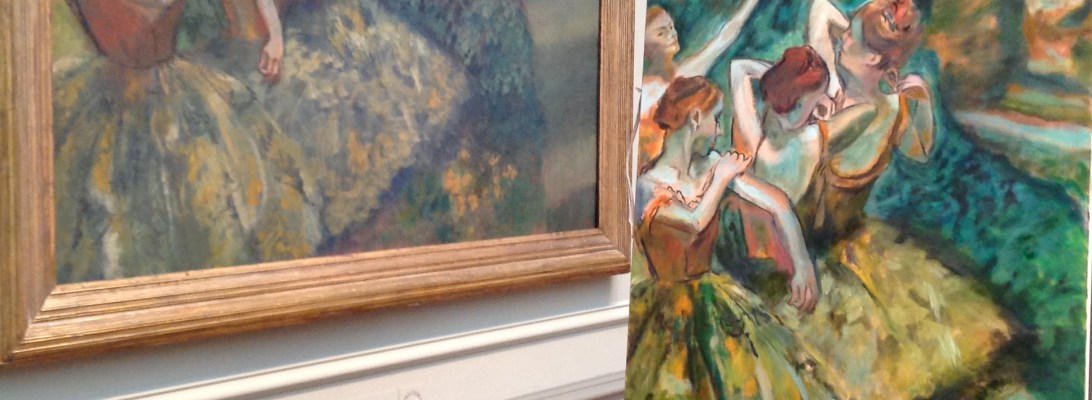
Four Dancers – after Edgar Degas

Work in progress. I’ve been working on this piece for five Tuesdays, approximately 22 hours. Lots of defining and details left to complete. I’m trying to imagine how the painting looked when Degas finished it.  My feeling is that the colors he used were much brighter than the original looks today.  The impressionist loved to paint the light so I can’t imagine he painted Four Dancers in such a dull, dark form.

Degas loved to paint ballerinas and also loved to work with pastels, preferring the chalky look in his work.  When painting in oils, he often would lay out his colors on a cardboard instead of a wooden palette so the oil could be absorbed out of the paint.  This would give the thin wash a pastel look.  Did you know that in Four Dancers, he used only one model posed in four different positions?

The National Gallery of Art currently has a wonderful Degas/Cassatt exhibit, running through October 5, 2014.  A MUST SEE! The affinity between the two artists is undeniable.  Both were realists who drew their inspiration from the human figure and the depiction of modern life.

If you happen to come by on a Tuesday, stop by and visit me.  I’m in the Impressionist Gallery #83 for at least another two Tuesdays.

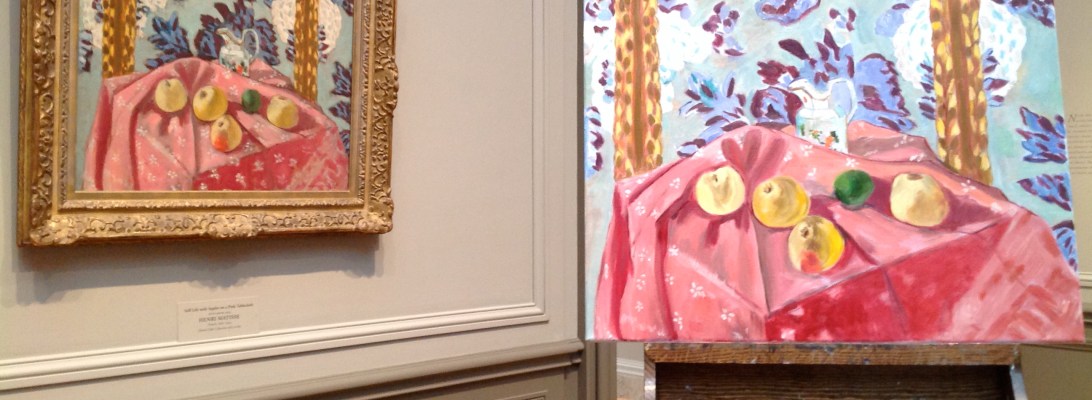
Still Life with Apples – Day 3

The copy is almost complete.  I expect to finish it next Tuesday.  The details are always a challenge and I will soon examine the painting to make sure every square inch is accurate.  I am beginning to think about my next copy.

New Copy – “Woman with a Parasol”

On Tuesday, March 12th I began a new copy, Woman with a Parasol – Madame Monet and Her Son by Claude Monet 1875.  Landscape painting was a subject that Monet favored.  His skill as a figure painter is equally evident.  Monet delieneated the features of his sitters as freely as their surroundings.  He painted in a very spontaneous manner, outdoors, and probably in a single session with the intention to convey the feeling of a casual family outing rather than a formal portrait.  It is believed that he painted this masterpiece in about four hours.  The brevity of the moment portrayed is conveyed by a repertory of animated brushstrokes of vibrant color with the clouds being the most difficult to replicate because of the freedom and spontaneity of the brushstrokes and his style. I often wonder what Monet was thinking as he painted Woman with a Parasol.  In this case I think that Madame Monet is saying, “Claude, hurry it up, its windy up here.”

Woman with a Parasol is one of Monet’s most popular works and attracts a great deal of visitors to the National Gallery of Art.  I enjoy the opportunity to be able to speak and discuss this masterpiece with the public.

Paul Cezanne “Riverbank” Day 4

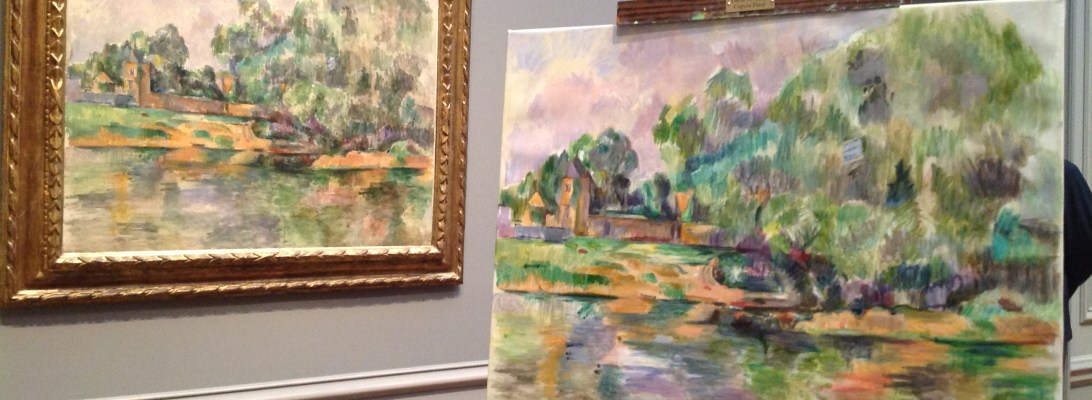
Looking at the latest photo of “Riverbank” you can’t see much difference between the previous weeks photo images and the current one.  One needs to see it in person and get up close to study the variations.  After an additional 5 hours of copying “Riverbank,”  I’m beginning to feel it is coming close to the end.  My last session will be toning down colors with glazes in order to make the painting look more like the original.  As I’ve mentioned many times before, my copies are always brighter in color, the result of newer, fresher paint.  Often the public prefers the brighter look.

By 1886, a year after Cezanne completed “Riverbank,” his financial troubles were at an end and he was free to pursue his commitment to painting without outside interference.  He preferred to spend his days in solitary pursuit of those ambitions in painting which were as vivid to him as they were obscure to others.  He begins to paint with confidence and robustness, with an ambition and clarity about his work that suggest an artist coming to terms with his own temperament and realization.  Many of Cezanne’s most distinctive subjects, like “Mont Ste-Victoire” and the “Card-Players,” made their definitive appearance at this time. The paintings of this period of his life show a rich interplay of colors, gestures and a massiveness that reminds us of the hard-won mastery that Cezanne had achieved in his thirty years as a painter.

The weather is getting milder (we hope) and visitors and art lovers are starting to venture out to see the sights in Washington, DC and the great new exhibits at the National Gallery of Art.  I look forward to seeing friends and family at the NGA.  Let’s have lunch together, I’m in gallery #84.

Paul Cezanne – Riverbank

On Tuesday, January 28,  I began a copy of Paul Cezanne’s 1895 painting “Riverbank”, a very abstract piece compare to most of my copies.  After completing Vincent Van Gogh’s “Roses”, which was painted mostly in Impasto, I had to adjust my style, loosen my grip on the brush, dilute the paint to a transparent format, and paint quickly. The beginning was rather hesitant, not feeling the mood Cezanne might have felt as he dashed the paint all over the canvas. But after about an hour I began to feel the flow of the paint. It is obvious to me that Cezanne didn’t under paint but he definitely layered his paint strokes and in some areas allowed the paint to drip down on the canvas. I’m not an extremely neat artist so this process was not difficult for me. In fact, it was rather enjoyable to allow myself to be so loose and free. My preliminary drawing helped with the placement of shapes but the thin washes of paint did not cover the pencil lines and marks so I will have to work on removing them as I progress.  Cezanne liked to work on a nearly white surface allowing some of the background to show through. Duplicating the tones and hues presents a challenge as it does with most of the masterpieces. Old paint fades with time. My colors are fresh so there is naturally a difference but I will try my best to develop the painting as close to the original colors as possible.

To my surprise, this painting attracted much attention for the first day. A copy is often ignored on day one. Usually, there is not much to look at but “Riverbank” moved along quite quickly. At the end of the session most of the canvas had some paint on it although there is much to be done and a bit more splattering to do.

Unless snow or some mysterious power shuts us down, Paul Cezanne and I will be in gallery #84, National Gallery of Art, for the next several Tuesdays. Stop by and say hello.

Happy Holidays

Happy Holidays from Frederick, Maryland 2013

I would like to share a quote from Fritz Scholder, an artist whose work has been exhibited at the Institute of American Indian Arts Museum in Santa Fe, New Mexico.  His words captured my attention, especially at this time of year when we’re all caught up in the hustle and bustle of the holidays.  My hope is that this message will be inspirational to everyone .

Spend time patting a dog or cat.  Look up and down.  Believe in the unknown, for it is there.  Live in many places.  Live with flowers and music and books and paintings and sculpture.  Keep a record of your time.  Learn to write well.  Learn to read well. Learn to listen and talk well.  Know your country, know the world, know your history, know yourself.  Take care of yourself physically and mentally.  Be good to yourself.  You owe it to yourself.  Be good to those around you.  And do all of these things with passion.  FRITZ SCHOLDER, MAY 12, 1983

For me it is a learning process.  Something I will continue to work on for the rest of my life.  

Dan and I wish all of you a very happy and blessed holiday season and a healthy 2014.