Paul Cezanne – Riverbank

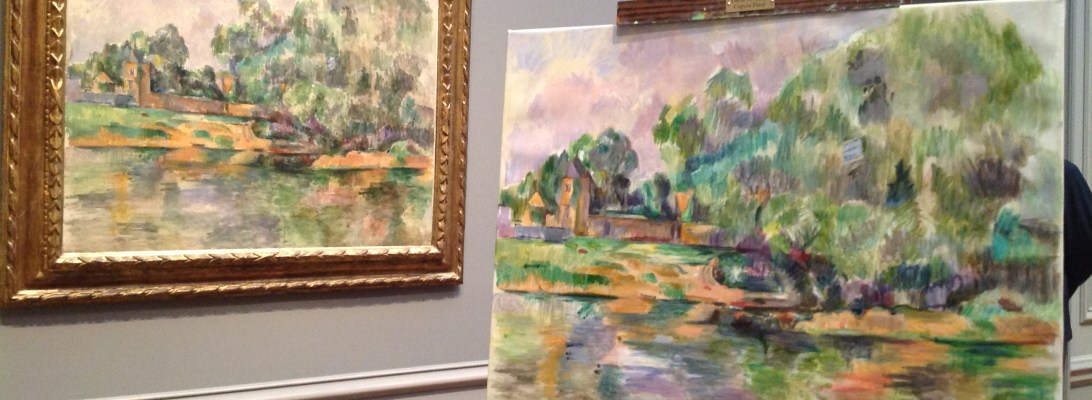
On Tuesday, January 28,  I began a copy of Paul Cezanne’s 1895 painting “Riverbank”, a very abstract piece compare to most of my copies.  After completing Vincent Van Gogh’s “Roses”, which was painted mostly in Impasto, I had to adjust my style, loosen my grip on the brush, dilute the paint to a transparent format, and paint quickly. The beginning was rather hesitant, not feeling the mood Cezanne might have felt as he dashed the paint all over the canvas. But after about an hour I began to feel the flow of the paint. It is obvious to me that Cezanne didn’t under paint but he definitely layered his paint strokes and in some areas allowed the paint to drip down on the canvas. I’m not an extremely neat artist so this process was not difficult for me. In fact, it was rather enjoyable to allow myself to be so loose and free. My preliminary drawing helped with the placement of shapes but the thin washes of paint did not cover the pencil lines and marks so I will have to work on removing them as I progress.  Cezanne liked to work on a nearly white surface allowing some of the background to show through. Duplicating the tones and hues presents a challenge as it does with most of the masterpieces. Old paint fades with time. My colors are fresh so there is naturally a difference but I will try my best to develop the painting as close to the original colors as possible.

To my surprise, this painting attracted much attention for the first day. A copy is often ignored on day one. Usually, there is not much to look at but “Riverbank” moved along quite quickly. At the end of the session most of the canvas had some paint on it although there is much to be done and a bit more splattering to do.

Unless snow or some mysterious power shuts us down, Paul Cezanne and I will be in gallery #84, National Gallery of Art, for the next several Tuesdays. Stop by and say hello.
Happy Holidays

Happy Holidays from Frederick, Maryland 2013

I would like to share a quote from Fritz Scholder, an artist whose work has been exhibited at the Institute of American Indian Arts Museum in Santa Fe, New Mexico.  His words captured my attention, especially at this time of year when we’re all caught up in the hustle and bustle of the holidays.  My hope is that this message will be inspirational to everyone .

Spend time patting a dog or cat.  Look up and down.  Believe in the unknown, for it is there.  Live in many places.  Live with flowers and music and books and paintings and sculpture.  Keep a record of your time.  Learn to write well.  Learn to read well. Learn to listen and talk well.  Know your country, know the world, know your history, know yourself.  Take care of yourself physically and mentally.  Be good to yourself.  You owe it to yourself.  Be good to those around you.  And do all of these things with passion.  FRITZ SCHOLDER, MAY 12, 1983

For me it is a learning process.  Something I will continue to work on for the rest of my life.  

Dan and I wish all of you a very happy and blessed holiday season and a healthy 2014.  

Holiday Ornaments

It seems as if the holidays began in October.  I’m not the only one thinking this way;  others have expressed the same feeling.  This past Tuesday it felt strange not to be at the National Gallery of Art working on my copy of Vincent van Gogh’s “Roses.”  It was grandparents day at our granddaughter Caroline’s school, a yearly event we attend with joy and pride.  I’ll be back at the NGA next Tuesday and expect to be closer to completion of my copy.

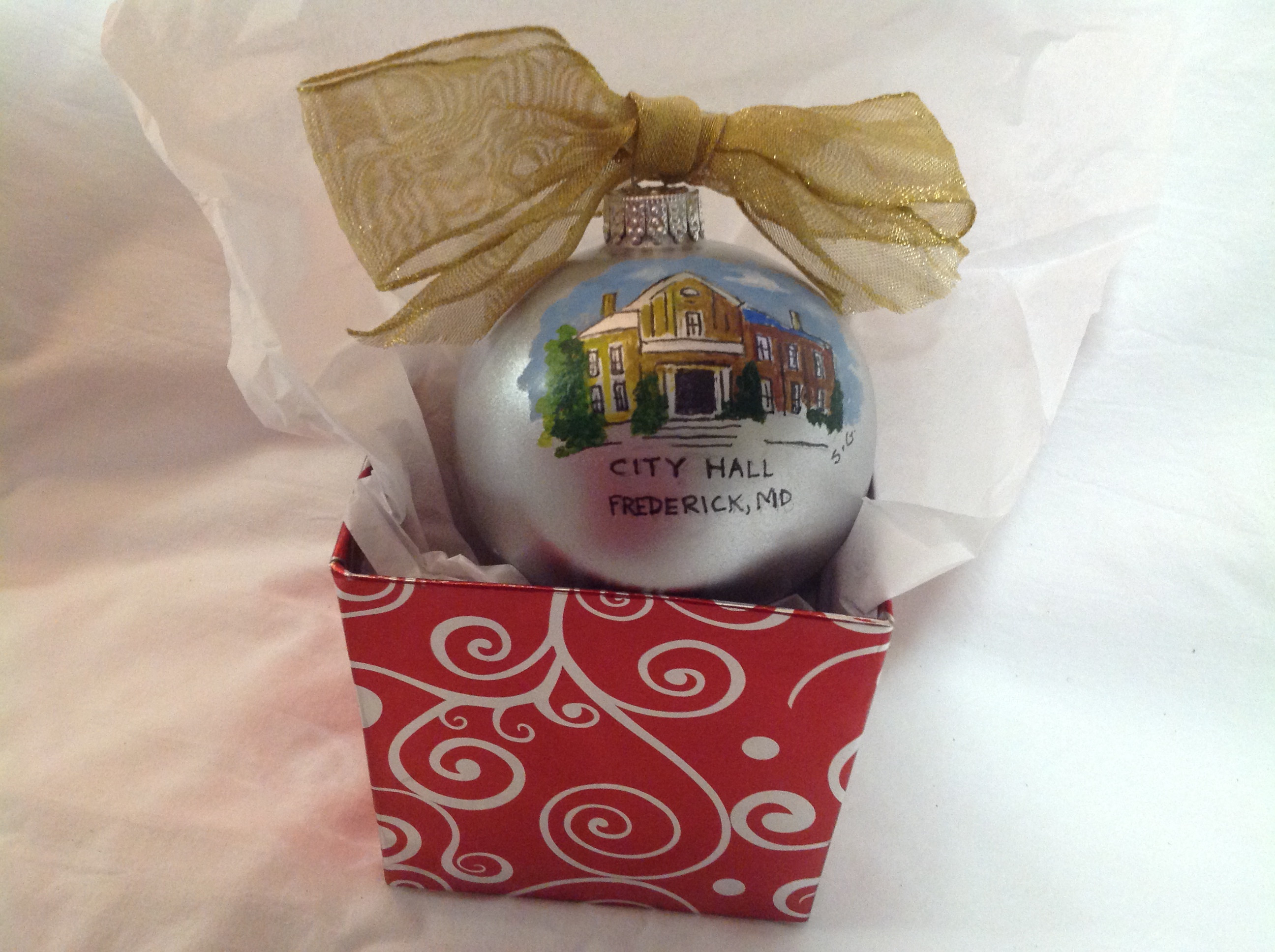
This year I decided to create holiday ornaments depicting scenes of Frederick, Maryland.  Each ornament is hand painted in acrylic and shows a popular landmark around downtown.  The scenes are painted on glass ornaments from photographs I’ve taken and been collecting throughout the years.  Someone asked me to do a portrait of their home on an ornament so I thought painting Frederick scenes would be a fun project.  I’m going to try to paint a small facial portrait on one.  That will be a challenge!  Although, last year for a class assignment, our teacher asked us to paint a portrait the size of a quarter.  I didn’t think it was possible but I managed to pull it off. We’ll see what happens.

The Frederick ornaments may be seen in the gift shop of The Delaplaine Visual Arts Education Center, 40 South Carroll St., Frederick, MD (301)698-0656.

I wish all of my friends, family and followers a very happy and safe Thanksgiving.

Vincent van Gogh Roses in Pink

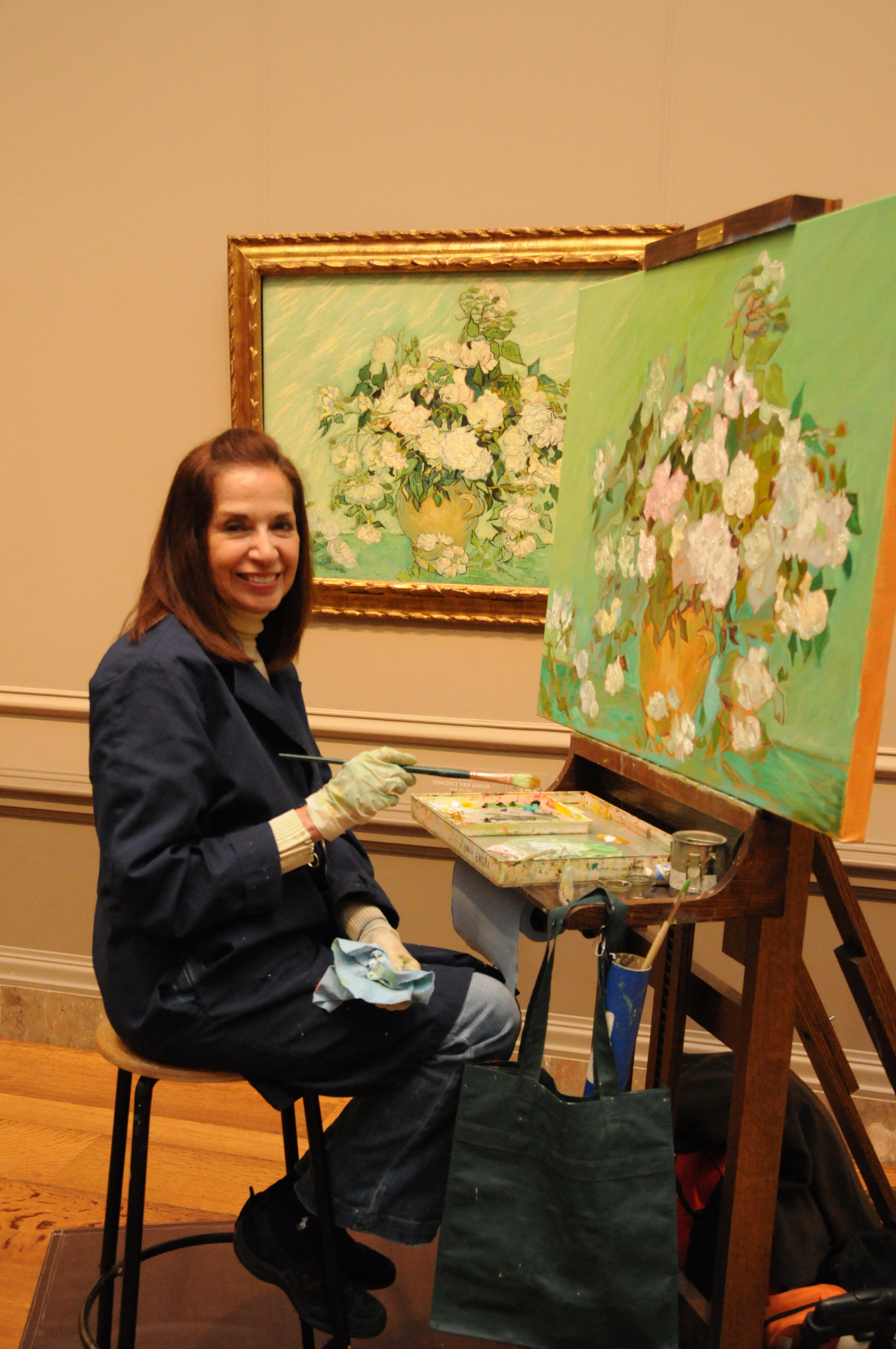
Painting at the NGAMany may not realize that Vincent van Gogh created several versions of “Roses”.   The masterpiece created by VanGogh, “Roses” that is in the National Gallery of Art in Washington, D.C. was painted in 1890, shortly before he was released from the asylum at Saint-Remy.  It is among his largest and most beautiful still lifes, with an exuberant bouquet in the glory of full bloom.

Originally, the roses were pink which would have made a beautiful compliment with the green background.  However, the pink has faded throughout the years.  It is difficult to determine which roses and how many were originally pink. I am in the process of copying this piece for the second time.  The first time I copied it just as the it looks today.  For the second try, after doing some research, I took the liberty of painting it in the manner that I believe van Gogh created the original–with the pink roses.  After careful observation, I decided that the flowers that have the slightest tinge of pink were probably the ones that he painted in pink. It’s been fun to see how this painting has evolved and how it will end up.  It should be completed in about one more session.

One can view the original creation as well as my copy on Tuesdays from 10:30 AM until about 4:00 PM in the Impressionist Gallery #83.

Holiday Cards


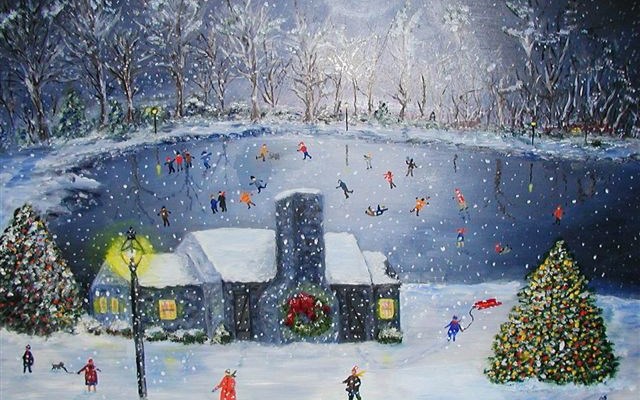
These images are of cards from past years and are available for purchase at “The Candy Kitchen” 52 N. Market St. Frederick, Maryland, and at the “Delaplaine Visual Arts Education Center” 40 S. Carroll St. Frederick, MD beginning in October.  They may also be special ordered through this web-site.  See HOW TO PURCHASE/COMMISSIONS.

The Metropolitan Museum of Art

MET - NYC full view
Copying Renoir “Still Life with Peaches”

I’ve put another check mark on my bucket list.  As a high school student living in New York City, I often took trips to the Metropolitan Museum of Art. As I walked through the great galleries, the feelings I experienced were multiple.  It was almost unrealistic that someone could actually paint such magnificent works of art.  I remember being entranced, walking around in a state of awe, not quite understanding what I was feeling, but happy to be there soaking in such beauty and color while observing the unbelievable skills of the master artists.

During the time period of July 8 through July 19, 2013, I realized a dream I thought could never happen. I became a Copyist at the Metropolitan Museum of Art.  I was doing what I loved in my own home town –  the beloved city of New York.  After a long application process I was accepted in the program, one of five copyists selected for the summer season.  I copied Auguste Renior’s “Still Life with Peaches.” It was an unbelievable experience to be so close to that magnificent painting.  I met art lovers from all over the world, exchanged stories, answered many questions while loving everyday and every moment.  The museum staff was wonderful and helpful.  The copy drew tremendous interest and many positive comments from the patrons.

A special thanks to my dear friends Camille and Joe who opened their city apartment to me.  It is conveniently located and enabled me to travel daily to the MET with a load of art supplies.  Without their generosity and support, this experience may have never happened.

Renoir and I visit Le Pont Neuf in Paris

On May 21, I began work on “Pont Neuf, Paris” by Auguste Renoir.  This may be the most challenging of my work at the NGA.  The enormity of the details, particularly the many windows in a city architectural scene, can be a tedious task as I’m sure it must have been for Renoir.  Most apparent here and the focal point of this painting is Renoir’s transcription of the effects of sunlight.  The midday sun suffuses the panorama, its intensity heightening the artist’s palette and suppressing incidental detail to clarify the crowded scene. Renoir pre-sketched the architecture before setting out to paint the remainder of the scene. I began my copy in the same manner.

Edmond Renoir, the artist’s younger brother and a novice journalist in 1872, later told how Renoir secured an owner’s permission to occupy an upper floor of a cafe for one day to depict the view of the famous bridge.  Edmond periodically delayed passersby long enough for the artist to record their appearance in the painting.  Renoir even noted Edmond’s presence in two locations, walking stick in hand and straw hat on his head.  Renoir wanted to show the energetic crowd walking across the sun-drenched pavement and going about their daily routine on this clear sunny day. He depicted vendors pushing carts carrying goods across the bridge, children at play, dogs chasing children, and the hustle and bustle of daily life. Does it make you wonder what is on the other side of the bridge?

I am at the NGA, Washington D.C. every Tuesday, (gallery 89 until the completion of this painting).  Stop by and say hello.

Master Copies from The National Gallery of Art in Washington, D.C.

This slideshow requires JavaScript.

The images in this gallery are authentic copies from the masters at The National Gallery of Art in Washington, DC.  Each piece is authenticated by the NGA as a copy from the original and painted in oil.  Most are on a linen surface. Some are on gallery stretchers and do not require framing as they are painted around the sides of the canvas.  Careful research and study was done to learn the process and use of color during the time period the original painting was created.  These one-of-a-kind works of art are available for sale.  Interested parties should contact me here.

I am also taking commissions to copy any master painting at the NGA that is available to me for copying. Visit the National Gallery of Art’s collection at www.nga.gov.

The Dancer – Auguste Renior

The Dancer after Renoir, in copyThe Dancer by Auguste Renior, is the largest copy I have attempted (30″x40″), the maximum size allowed by the NGA for a copy. The original measures 56 1/8″X 45 3/4″. All copies I have completed thus far presented a challenge but because of the size of The Dancer this one is even more complex. “The Dancer was one of seven works Renoir included in an exhibition in Paris which opened in April 1874 with a group of artists soon to be known as the impressionists. The Dancer inevitably calls to mind the work of Renoir’s fellow impressionist Edgar Degas, whose name is now synonymous with depictions of ballet dancers. The paintings scale and the figure’s prominence by being placed in the very center of the composition, dominate the entire canvas. Shown in profile, her silk-slippered feet placed in classic fifth position, Renoir’s dancer is poised and alert as she turns her gaze toward the viewer. Renoir accentuated the dancer’s youth and he masterfully captured the gauzy softness of the tulle which floats about her body like a cloud seeming to dissolve into the hazy background. The fabric as light and ethereal as mist. This painting, as did Degas’ “The Dance Lesson”, reminds me of my youth when I painfully endured ballet lessons and wanted so badly to learn to dance well and become a ballerina. It didn’t happen but I enjoyed it and now have had the thrill of producing a dancer on canvas.

The color in the digital photograph of the copy when compared to the original work appears to be different but when actually viewed in person they are as close as can be achieved taking into consideration that the original is over one hundred years older than the copy and the color has faded.